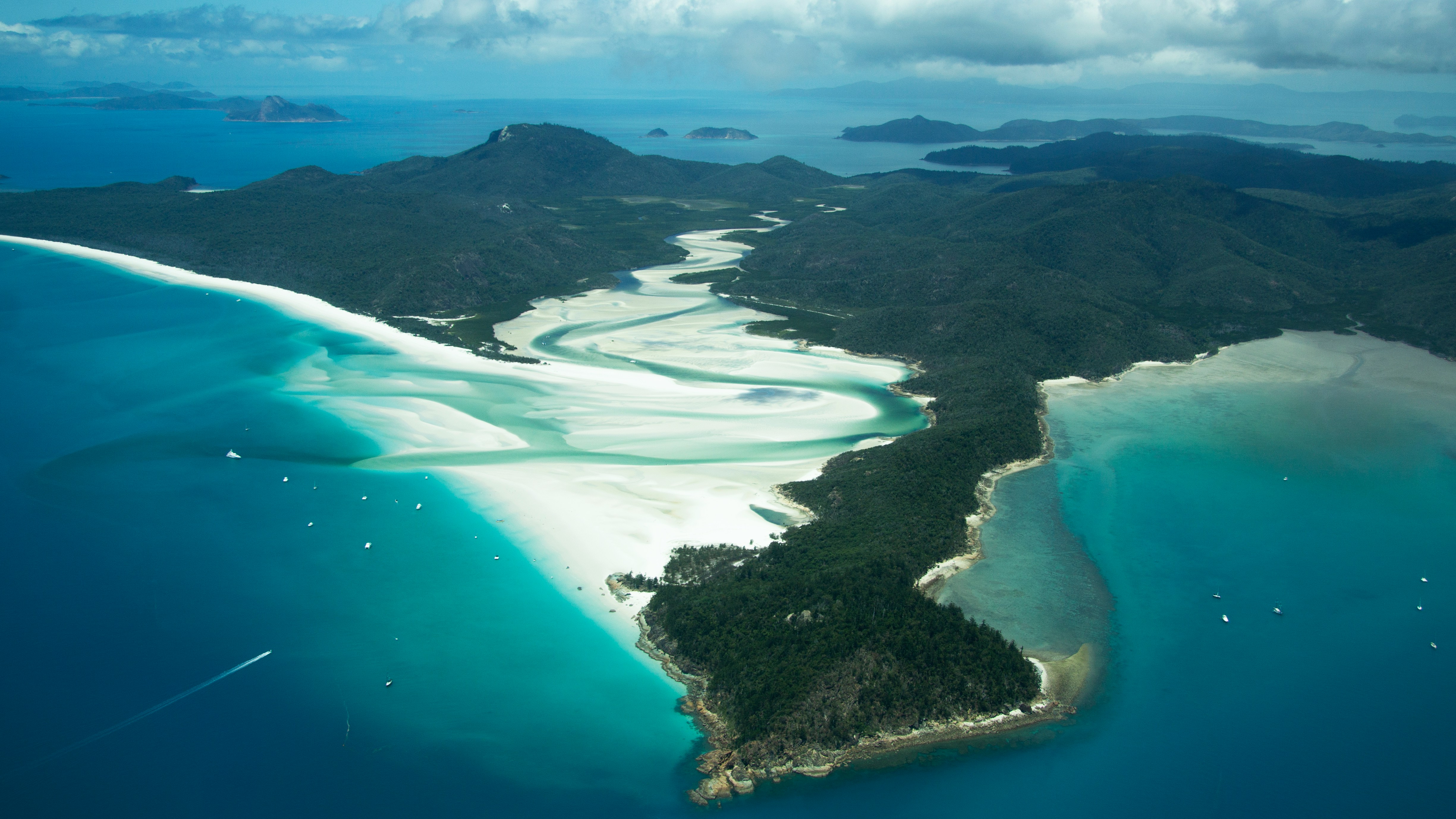
Whitehaven's silica sand and the swirling tidal patterns of Hill Inlet are the Whitsundays' signature image.
If you're an Australian who keeps scrolling past photos of the Maldives or the Seychelles thinking "one day", it's worth remembering that one of the most photographed beaches on earth is a domestic flight away. The Whitsundays are a group of 74 islands off the Queensland coast, tucked inside the Great Barrier Reef Marine Park, and their headline act — Whitehaven Beach — is the kind of place that makes overseas travellers fly halfway around the world.
It's also a destination people often misunderstand before they book. "The Whitsundays" isn't a single beach or a single island you check into; it's a region with a mainland hub, a resort island with its own airport, and dozens of mostly uninhabited islands you reach by boat. Where you sleep and how you get on the water decides almost everything about the trip — and the gap between a backpacker's sailing week and a couple's resort escape is huge. This guide is about getting that decision right.
What actually makes it special
Two things, really. The first is Whitehaven Beach itself, on Whitsunday Island — a long stretch of exceptionally fine, bright white silica sand that stays cool underfoot and squeaks when you walk on it. At its northern end is Hill Inlet, where the tide pushes the white sand and turquoise water into shifting, marbled swirls; the lookout above it is the shot you've seen a thousand times. There are no roads or resorts on the beach itself, so it's a place you visit by boat, not one you stay on.
The second is the Great Barrier Reef. Because the islands sit within the marine park, the Whitsundays double as a world-class snorkelling and diving base, with fringing reefs around the islands and trips out to the outer reef. The famous Heart Reef — a natural heart-shaped coral formation — can't be swum to, but it's a favourite of the scenic flights that buzz over the reef and Whitehaven.
The mistake isn't choosing the wrong island. It's not realising you're choosing between a hub, a resort, and a boat.
The three ways in — and where to base
There are three main gateways, and each suits a different kind of trip and budget. Pick your base first; the activities follow from it.
Airlie Beach — the mainland hub
The backpacker-and-everyone-else town on the mainland, and the launch point for most tours, sailing trips and day boats. This is where you base if you want choice and value: a wide range of stays from hostels and budget rooms up to comfortable hotels, plenty of restaurants and a lagoon to swim in, and the biggest selection of operators heading out to Whitehaven and the reef. For most first-timers, and for almost anyone watching the budget, Airlie Beach is the sensible home base.
Hamilton Island — the resort island
The most developed of the islands, with its own airport (HTI) so you can fly straight in, plus resorts, restaurants, beaches and easy boat connections to Whitehaven. This is the splurge-and-convenience option — you trade the variety and value of the mainland for the polish of staying out on an island. Good for couples and families who want the resort experience and don't mind paying for it.
Proserpine / Whitsunday Coast Airport (PPP) — the budget gateway
The mainland airport that typically sees cheaper flights than Hamilton Island, with a transfer down to Airlie Beach. If you're flying in to base on the mainland, this is often the more economical way to arrive. (Many travellers fly into PPP, base at Airlie, and only set foot on the islands by boat.)
Where to stay, by budget
The Whitsundays stretch across a genuinely wide price range, which is part of the appeal — a backpacker on a sailing trip and a honeymooning couple can both have the holiday of a lifetime here. As a rough sense of what to expect (always check live prices for your dates, as they swing with season):
- Tight budget — hostels and budget rooms in Airlie Beach, plus the multi-day liveaboard sailing trips where your bed is a bunk on the boat. The cheapest, most social way to do it.
- Mid-range — comfortable hotels and apartments in and around Airlie Beach, day tours out to Whitehaven and the reef from there. The sweet spot for most couples and families.
- Splurge — island resorts on Hamilton and the more exclusive island stays, where you pay a real premium to wake up out on the water.
A useful rule of thumb: the islands and resorts cost more for almost everything because supplies come in by boat, while Airlie Beach gives you mainland prices and the freedom to pick and choose your days on the water. Many people get the best of both by basing cheaply on the mainland and splashing out on one or two standout boat trips.
The Whitsundays are all about what you do on the water — day sails and boat tours to Whitehaven Beach and Hill Inlet, reef snorkelling and diving trips, and scenic flights over the reef. Klook lists Whitsundays tours and activities you can compare and pre-book, which beats turning up in Airlie Beach hoping there's a spot left on a peak-season day.
Browse Whitsundays tours on Klook →Affiliate link — if you book through it we may earn a small commission, at no extra cost to you. We only link to things that genuinely fit the trip.
What to actually do
- A day trip to Whitehaven & Hill Inlet — the essential one. Boat tours run from Airlie Beach and Hamilton Island; the Hill Inlet lookout is the must-see, ideally timed for the tide.
- Sailing — the signature Whitsundays experience, from a single relaxed day sail to a multi-day liveaboard trip that hops between islands and snorkel stops. Backpacker boats and more comfortable charters both exist.
- Snorkelling & diving — fringing reefs around the islands plus trips to the outer Great Barrier Reef. World-class, and beginner-friendly with a guide.
- A scenic flight — the splurge that's often worth it: seaplanes and helicopters loop over Whitehaven, the reef and the heart-shaped Heart Reef you can't reach any other way.
When to go (and the stinger thing)
The reliable window is the dry season, roughly August to October — warm days, lower humidity, and clearer water, which is exactly what you want for snorkelling and time on the boats. It's also the most pleasant time to be out on the water generally, so it's popular; book the better trips ahead.
The one safety note every visitor should know is stinger season: roughly November to May, when potentially dangerous box jellyfish are present in the warmer coastal waters. It doesn't shut down the holiday — operators provide stinger suits, there are netted swimming enclosures, and time on the boats and the famous beach goes ahead — but swimming in open water during those months needs proper precautions. If beach-and-swim is your whole reason for going, the dry season skews the odds in your favour.
Honest tips that save the trip
- Base on the mainland, splurge on the water. For most people Airlie Beach plus one or two great boat trips beats paying island-resort prices for every night.
- Pre-book your Whitehaven or sailing trip in peak dry season — the good operators fill up, and arriving without a booking is how you miss the day you came for.
- Mind stinger season. If you're visiting November to May, plan to use stinger suits and netted areas, and lean on the boat-based days.
- Decide early: hub, resort or boat. The whole trip flows from that one choice — re-read the three gateways above and match it to your budget and the kind of holiday you want.
None of this is complicated once you see the shape of it — and that's rather the point. The Whitsundays reward a little planning more than they reward spending, because the magic is on the water, not in the room you booked. Get the base, the season and the boat trips right, and you'll understand why people fly across the world for a beach that, for Australians, is essentially in the backyard.
Go deeper
Questions
Are the Whitsundays worth visiting?
For a world-class beach and reef trip, yes — and for Australians especially, it's a domestic flight to scenery people travel internationally to see. Whitehaven Beach and Hill Inlet genuinely live up to the photos, and the islands double as a Great Barrier Reef snorkelling and diving base.
Where should I stay in the Whitsundays?
For most people and most budgets, Airlie Beach on the mainland — it has the widest range of stays, the most tours, and lets you pick your days on the water. Hamilton Island is the splurge option if you want to wake up out on an island with resort comforts. Whitehaven Beach itself has no accommodation; you visit it by boat.
When is the best time to go?
Roughly August to October, in the dry season — warm, less humid, with clearer water that's ideal for snorkelling and boat trips. Note "stinger season" from about November to May, when box jellyfish mean open-water swimming needs stinger suits or netted areas.
How much does a Whitsundays trip cost?
It spans a wide range. You can keep it cheap with a hostel or budget room in Airlie Beach and a backpacker sailing trip, or spend freely on an island resort and scenic flights. A common middle path is a mainland base plus one or two standout boat trips. Costs move with season and operator, so check current prices.
How do you get to the Whitsundays?
Fly into Proserpine / Whitsunday Coast Airport (PPP) for cheaper flights and a transfer to Airlie Beach, or straight into Hamilton Island (HTI) if you're staying on the island. From Airlie Beach you reach Whitehaven and the reef by boat — day tours or multi-day sailing trips.
This guide is researched and cross-checked rather than a personal trip report, and is general information only. Costs are given as rough bands because they vary with season, operator and exchange rates — always check current prices, boat conditions, stinger-season advice and any travel advisories for your dates before booking.