Slapped onto a hot clay wall and peeled off blistered — Georgian bread is half craft, half spectacle.
In Georgia, bread isn't quietly stacked behind a counter — it's made in front of you, and the making is a small piece of theatre. A baker reaches deep into a glowing clay oven, presses a shaped piece of dough onto the wall, and a few minutes later peels off a blistered, crusty loaf still too hot to hold comfortably. For a country with a food culture as old and as proud as Georgia's, bread is where a lot of the drama starts. If you only watch one thing being made in Tbilisi, make it this.
Shotis puri and the clay tone oven
The everyday bread you'll see most is shotis puri — often just called shoti — a long loaf with a distinctive pointed, canoe-like or eye-shaped form. What makes it so striking isn't the shape so much as the method. It's baked in a tone (also written toné): a deep, round, well-like clay oven, fired hot, with the heat radiating off its curved inner walls.
The baker stretches and shapes each piece of dough, then leans into the mouth of the oven and slaps it directly onto the hot clay wall, where it sticks and bakes fast. Minutes later it's lifted away — blistered and charred in spots, crisp on the outside, soft and chewy within. Eaten warm, straight from the tone, a good shoti needs nothing at all. It's the kind of bread that's almost better as a snack on the walk home than as something you carry to the table, much like a fresh baguette in Paris.
Bread baked on a wall of fire — Georgia turns the everyday loaf into a performance.
Khachapuri: the cheese bread everyone falls for
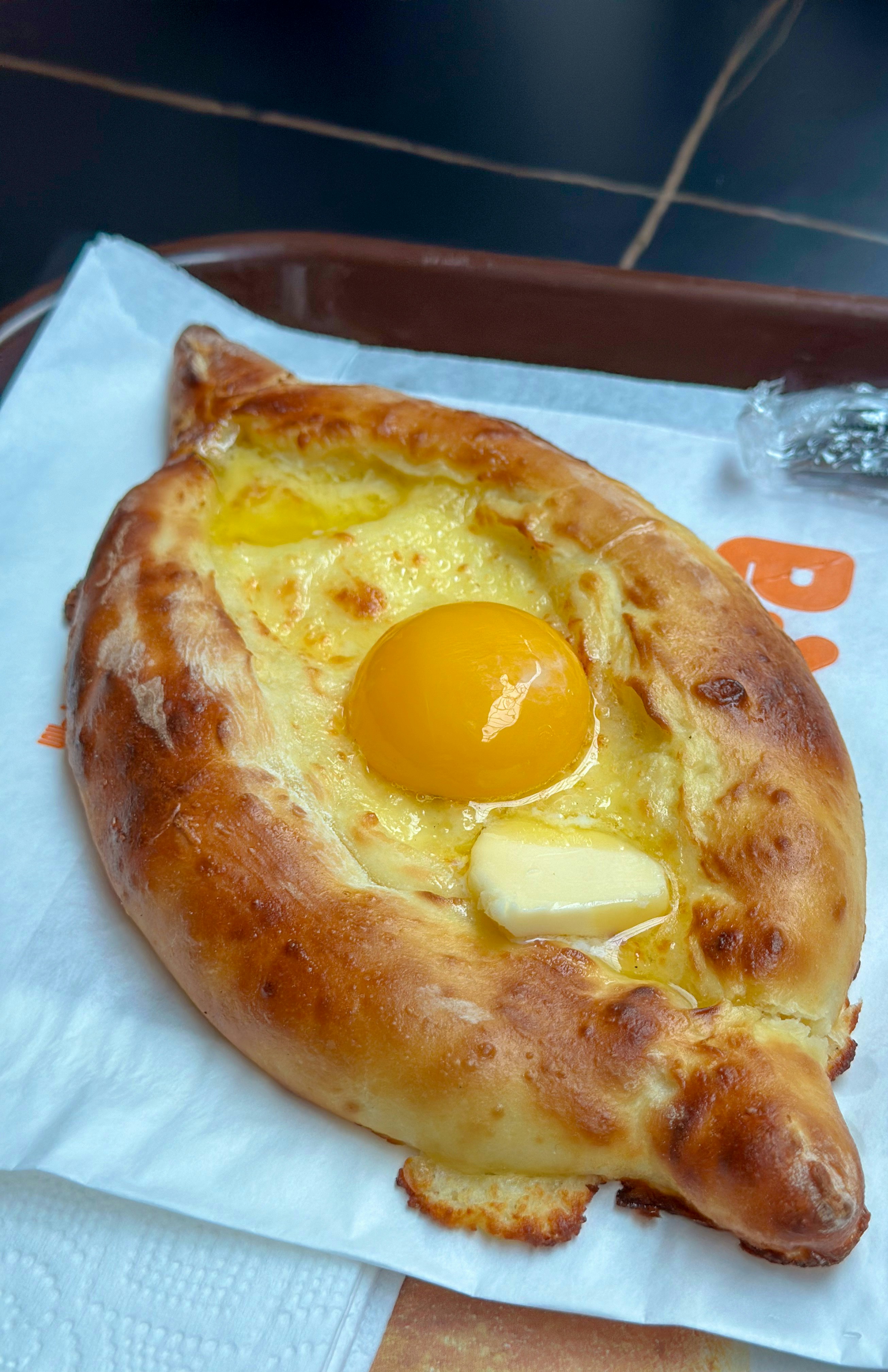
If shoti is the daily staple, khachapuri is the showstopper — Georgia's beloved cheese-filled bread, and for many travellers the first dish they fall hard for. The name simply points to what it is: bread with cheese. There are several regional versions, but the one that tends to win hearts is the Adjarian (often written Adjaruli), from the Black Sea region of Adjara.
The Adjarian version is shaped like an open boat, the dough pinched up at the ends to hold a pool of molten cheese. It arrives at the table dramatically finished: a raw egg yolk dropped into the centre, with a knob of butter, both stirred through the hot cheese so it all melts together into something rich and glossy. You tear off the bready ends and dip them into the middle. It is, by any honest measure, an indulgent dish — and that's rather the point.
It's worth saying that Georgians take their regional breads seriously, and exactly which version is "best" is the sort of thing people will happily argue about over a long meal. If you're new to it, trying both a plain shoti from a bakery and one good Adjarian khachapuri makes for a fine introduction.
Bread's place at the Georgian table
To understand why bread matters so much here, it helps to know about the supra — the traditional Georgian feast. A supra is less a meal than an event: a table loaded with many dishes at once, lots of wine, and a steady run of toasts led by a tamada, the toastmaster who keeps the rhythm of the evening going. Bread is part of the furniture of that table — torn, shared, and used to scoop and mop alongside everything else.
Georgia also has one of the world's oldest wine traditions, and in recent years its food and wine together have become a genuine reason to travel. None of that grandeur changes the simple pleasure at the centre of it, though: warm bread, pulled apart by hand, shared with the people around you.
A few simple ways to enjoy it well:
- Eat shoti fresh and warm, ideally straight from a bakery with a working tone — that's when its crust and chew are at their best.
- Order one good Adjarian khachapuri and don't be shy about the egg-and-butter ritual; stir it through while it's molten.
- Share, don't hoard. Bread here is a communal thing — it belongs in the middle of the table, not on a single plate.
- Pace yourself if you find yourself pulled into a supra; the toasts and the dishes keep coming.
Go deeper
Questions
What is shotis puri?
Shotis puri (often just shoti) is the classic Georgian loaf — long, with a pointed canoe- or eye-shaped form. It's baked by slapping shaped dough onto the inner wall of a hot clay oven called a tone, then peeling it off blistered and crusty. It's best eaten fresh and warm.
What is a tone oven?
A tone (also written toné) is a deep, round, well-like clay oven fired hot from within. The baker presses dough directly onto its curved inner walls, where it sticks and bakes quickly in the radiant heat. It's the same broad family of oven you'll find across parts of the Caucasus and beyond, under different names.
What makes Adjarian khachapuri different?
Adjarian (Adjaruli) khachapuri is the boat-shaped version filled with molten cheese, then finished with a raw egg yolk and a knob of butter stirred into the hot centre. You tear off the bready ends and dip them in. It's the most theatrical and indulgent of the regional khachapuri styles.
What is a Georgian supra?
A supra is the traditional Georgian feast — a table laden with many dishes at once, plenty of wine, and a run of toasts led by a toastmaster called the tamada. Bread is part of the shared table, torn and used to scoop alongside everything else. It's as much a social ritual as a meal.
Is Georgian food a good reason to visit Tbilisi?
Many travellers think so. Georgia pairs an ancient wine tradition with a rich, distinctive cuisine, and its food scene has become a real draw in recent years. Fresh-from-the-oven bread and a good khachapuri are an easy, affordable way into all of it — best enjoyed warm and shared.
This guide is researched and cross-checked rather than a personal trip report, and is general information only. Names, spellings, regional styles and customs can vary — check locally for current information, and mind any dietary or allergy needs before tucking in.