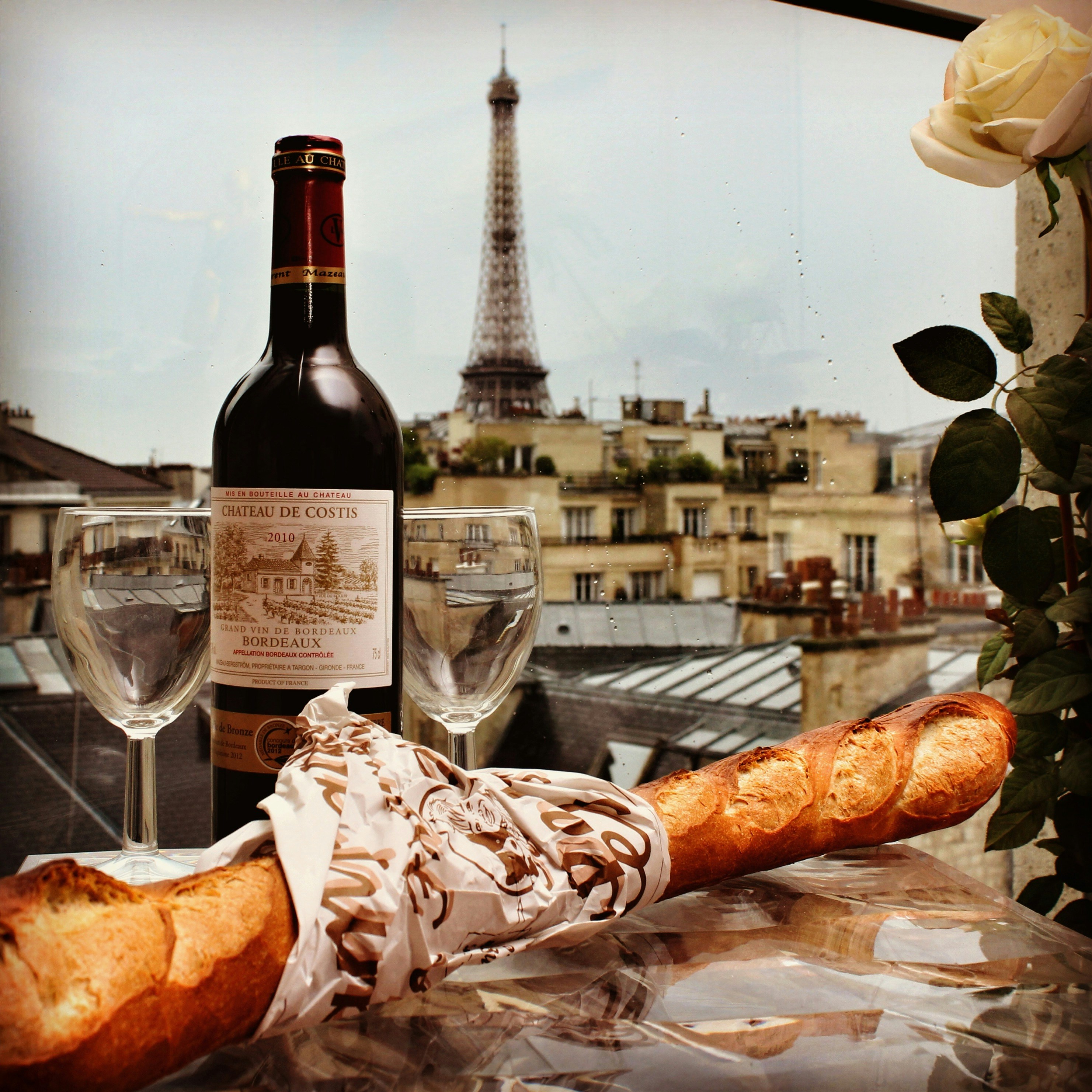
Simple ingredients, serious craft — that's the whole story of the baguette.
A great baguette is one of the purest things in food: flour, water, yeast, salt, and nothing to hide behind. There's no sugar, no fat, no improver to paper over a lazy method — which is exactly why a real Parisian baguette is such a good test of a baker, and such a quiet pleasure to eat. The story of how this plain stick of bread became a national symbol is more interesting than you'd think.
Where the long thin shape came from
Bread has been central to French life for centuries — but the baguette as we picture it, long and slim with a crackling crust, is really a creation of the early twentieth century. Nobody can point to a single inventor, and a few threads came together. Steam ovens arrived in Paris from Vienna in the 1800s, and that steam is what gives the baguette its glossy, crisp crust. A long, thin loaf also bakes faster than a big round one — handy, the story goes, once early-1900s labour laws limited how early bakers could start work, pushing them toward a quicker-baking shape. The word itself, baguette, simply means "wand" or "stick."
However it happened, by the twentieth century the slim loaf had become the everyday bread of Paris, bought fresh once or even twice a day — because with no preservatives, a real baguette is at its best for only a few hours.
The baguette has nowhere to hide. That's the point — and the test.
The law that protects the real thing
Because the baguette matters so much, France actually legislates it. A 1993 decree (often called the Décret Pain, the "bread decree") sets out what a baguette de tradition française must be: made on the premises where it's sold, from only flour, water, yeast and salt, with no additives and no freezing of the dough. That's why, in a French bakery, you'll often choose between an ordinary baguette and a baguette tradition — the "tradition" is the one held to that stricter, additive-free standard, and it's almost always the better loaf.
The reverence goes further still: in 2022, UNESCO added the artisanal know-how and culture of baguette bread to its list of intangible cultural heritage. A stick of plain bread, recognised by the world as something worth protecting.
What makes a good one
You don't need to be a baker to judge a baguette — your ears and eyes do most of the work:
- The crust should be deep golden and genuinely crackly — it should shatter and sing a little when you squeeze it.
- The crumb inside should be cream-coloured and open, with irregular holes, not tight and uniform like sliced sandwich bread.
- The scoring — those diagonal slashes (the grigne) — should have burst open and caramelised, a sign of a well-handled, well-proved dough.
- The smell and chew should be faintly nutty and lightly sour from a slow fermentation, never bland.
How to buy and eat it like a local
Go to a real boulangerie (look for "artisan" and a queue), not a supermarket, and ask for "une tradition, s'il vous plaît." Buy it the day you'll eat it — ideally still warm — and don't be surprised when the baker hands it over with just a twist of paper around the middle. The classic way to eat it is the simplest: torn by hand, with good butter, or used to mop a plate. Locals will happily nibble the crusty end (le quignon) on the walk home; consider that your reward for finding a good one.
Go deeper
Questions
What's the difference between a baguette and a baguette tradition?
An ordinary baguette can include additives and be made from frozen or transported dough. A baguette de tradition française is protected by a 1993 French law: only flour, water, yeast and salt, no additives, and made on site. The "tradition" is almost always the better, more characterful loaf.
Why does a real baguette go stale so fast?
Because it has no preservatives or fat — just flour, water, yeast and salt. That purity is what makes it so good fresh, and why Parisians buy it daily, sometimes twice a day. Eat it the same day; day-old baguette is for toasting or French toast.
Why is the baguette long and thin?
There's no single answer, but steam ovens from Vienna (which give the crisp crust) and early-1900s labour rules that pushed bakers toward a faster-baking shape both played a part. The slim "stick" became the everyday bread of Paris in the twentieth century.
How do I find a good baguette in Paris?
Choose an artisan boulangerie with a local queue over a supermarket, ask for a "tradition," and buy it fresh — warm if you can. A good crust crackles, the crumb is open and cream-coloured, and the scoring has burst open. Many neighbourhoods even have an annual "best baguette" winner worth seeking out.
This guide is researched and cross-checked rather than a personal trip report, and is general information only. Details of laws, customs and bakeries can change — check locally for current information, and mind any dietary or allergy needs before tucking in.