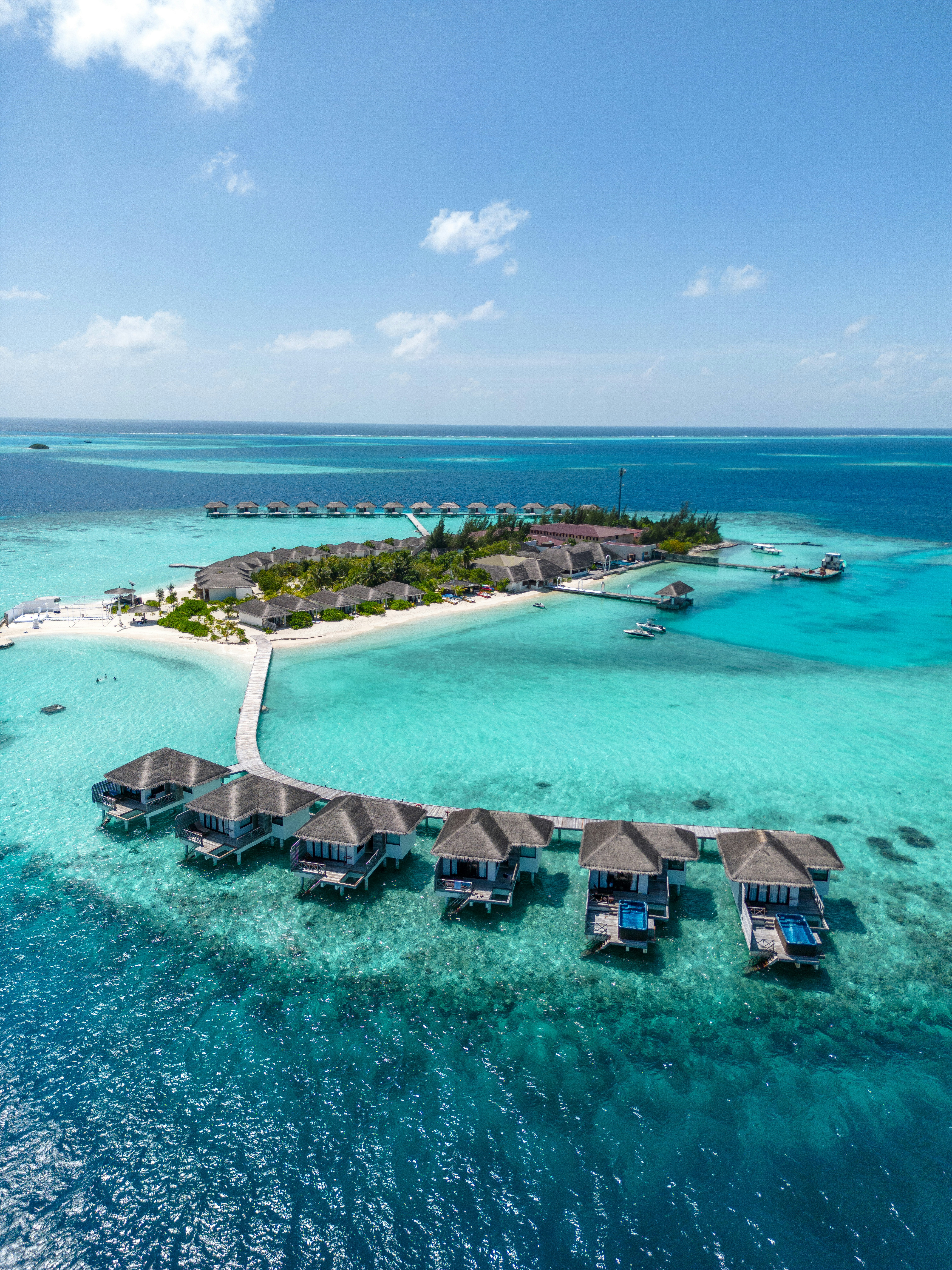
The classic image is real — but it's only one of two very different ways to do the Maldives.
The Maldives is a nation of more than a thousand low-lying coral islands, scattered in ring-shaped atolls across the Indian Ocean, southwest of Sri Lanka and India. It's the place that put the over-water villa on every honeymoon mood board: powder-white sand, lagoons in three shades of blue, and house reefs you can snorkel straight off the beach. What surprises most first-timers is how the country is actually organised — and how much that organisation decides your trip.
For decades the Maldives ran on one elegant, expensive idea: one island, one resort. You pick a resort island, you fly or boat out to it, and you essentially stay there for the whole trip — your hotel is the island. It's a beautiful model, and it's the reason the Maldives became shorthand for a splurge. But since roughly the 2010s a second, much cheaper route has opened up, and knowing both is the difference between a dream week and a quiet case of sticker shock.
The two Maldives
Before you look at a single hotel, understand that you're choosing between two genuinely different holidays that happen to share the same sea.
The resort island — the postcard
A private island given over entirely to one resort: over-water and beach villas, a couple of restaurants, a dive centre, a spa, and not much else by design. The appeal is total seclusion and a house reef on your doorstep. Swimwear is fine anywhere because the whole island is the resort. The catch is cost — you're a captive market for food, drinks and activities, and the price ladder runs from "expensive" to "frankly eye-watering."
The local island — the budget route
Since guesthouses were allowed on inhabited islands, ordinary travellers can stay among Maldivian communities for a fraction of resort prices. You get the same astonishing water and reefs, plus a glimpse of real island life. The trade-off is that these are Muslim communities: you dress modestly in public, and swimwear is usually limited to resort islands or a designated "bikini beach". Respect that and a local island can be both affordable and genuinely rewarding.
The expensive mistake isn't picking the wrong resort. It's not realising a far cheaper Maldives exists at all.
Where to stay, by budget
The Maldives spans a remarkable range once you know both routes exist. As a rough sense of what to expect — always check live prices, because they swing hard with season and how remote the island is:
- Budget — guesthouses on local islands, often closer to Malé to keep the transfer cheap. The affordable way in, with modest-dress rules in public and a bikini beach for swimming.
- Mid-range — smaller, simpler resort islands, or a comfortable local-island guesthouse paired with paid day trips to sandbanks and snorkel sites.
- Splurge — the famous over-water-villa resorts, frequently on more distant atolls reached by seaplane, where the setting (and the bill) is the whole point.
Whichever tier you pick, the single biggest hidden cost isn't the room — it's everything around it: the transfer to the island, the food-and-drink packages, and alcohol, which on resorts is the only place you'll find it at all. Build those in before you fall for a nightly rate.
Getting there (and the transfer that catches people out)
Everyone arrives the same way: an international flight into Malé (airport code MLE), near the capital. What happens next is a real cost and time decision, not a formality.
- Speedboat — used for islands closer to Malé. Quicker to fall back on, runs at most hours, and generally the cheaper option.
- Seaplane — the scenic transfer to more distant atolls, with those famous aerial views of the lagoons. It's a genuine highlight, but it's pricier and usually only flies in daylight, so a late arrival can mean an overnight near Malé first.
- Domestic flight + boat — for the farthest islands, sometimes a short internal flight then a final speedboat hop.
The point most first-timers miss: the transfer can add meaningfully to both the cost and the length of your trip, and it's tied to your flight times. Check how your resort or guesthouse gets you out there before booking flights, not after.
When to go
The Maldives has two broad seasons. The dry, high season — roughly November to April — is the reliable window: calmer seas, sunnier skies, the best underwater visibility, and also the busiest and priciest stretch. The wetter season, roughly May to October, is windier with more rain, but quieter and softer on price. There's no truly bad time to see that water — it's a trade between guaranteed sunshine and better value.
What to actually do
- Snorkel the house reef — the everyday magic. Many resorts and local islands have a reef you can swim to straight from the sand.
- Dive — the Maldives is a world-class diving destination, with reef life that rewards even a first open-water course.
- Sandbank and lagoon trips — half-day boat excursions to bare sandbanks and snorkel spots, especially good value from local islands.
- Marine life encounters — seasonal chances to swim with rays, turtles and bigger gentle giants on guided trips; book through your island or a reputable operator.
The Maldives is at its best under the surface — snorkelling and dive trips, sandbank cruises and island excursions. Pre-booking lets you compare what's included and lock in spots before they fill, rather than paying resort walk-up rates on the day.
Browse Maldives snorkel & island tours →Affiliate link — if you book through it we may earn a small commission, at no extra cost to you. It never changes what we recommend.
Honest tips that save the trip
- Decide resort vs local island first. It sets your whole budget and the feel of the trip — get this right before anything else.
- Price the transfer, not just the bed. A seaplane to a far atoll can quietly rival the room cost; closer islands keep it down.
- Budget for food, drink and alcohol. On resorts you're captive; weigh up a meal package, and remember alcohol is resort-only.
- Respect local culture on inhabited islands. Modest dress in public, swimwear at the bikini beach — it's the deal that keeps the budget route open.
The Maldives earns its reputation as a once-in-a-while splurge or honeymoon — the over-water-villa version really is as good as the photos. But the smartest planning move is simply knowing the budget path exists: a local-island guesthouse puts you on the same reefs for a great deal less, as long as you go in respecting how these islands live.
Go deeper
Questions
Is the Maldives worth visiting?
For the water and reefs, absolutely — it's one of the great beach and diving destinations. It's best treated as a once-in-a-while splurge or honeymoon, though a local-island guesthouse can make it far more affordable if you go in respecting local Muslim culture.
Resort island or local island — which should I stay on?
A resort island for total seclusion, over-water villas and swimwear anywhere, at a premium. A local-island guesthouse for a fraction of the price and a taste of real island life, with modest dress in public and swimming at a designated bikini beach.
When is the best time to visit the Maldives?
The dry, high season is roughly November to April — calmer seas, more sun and the best underwater visibility, but the busiest and priciest. Roughly May to October is wetter and windier but quieter and better value.
Why is the Maldives so expensive?
The biggest costs aren't always the room — they're the transfer out to your island, food-and-drink packages, and alcohol, which is limited to resorts. Distant islands reached by seaplane cost the most; staying closer to Malé or on a local island keeps things down.
How do you get to your island?
You fly into Malé (MLE), then transfer onward by speedboat for closer islands or by scenic seaplane for more distant atolls (sometimes a domestic flight plus a boat for the farthest). Seaplanes usually fly only in daylight, so check transfer timing against your flights before booking.
This guide is researched and cross-checked rather than a personal trip report, and is general information only. Costs are given as rough bands because they vary with season, atoll, transfer type and exchange rates — always check current prices, transfer arrangements and any travel advisories for your dates before booking.