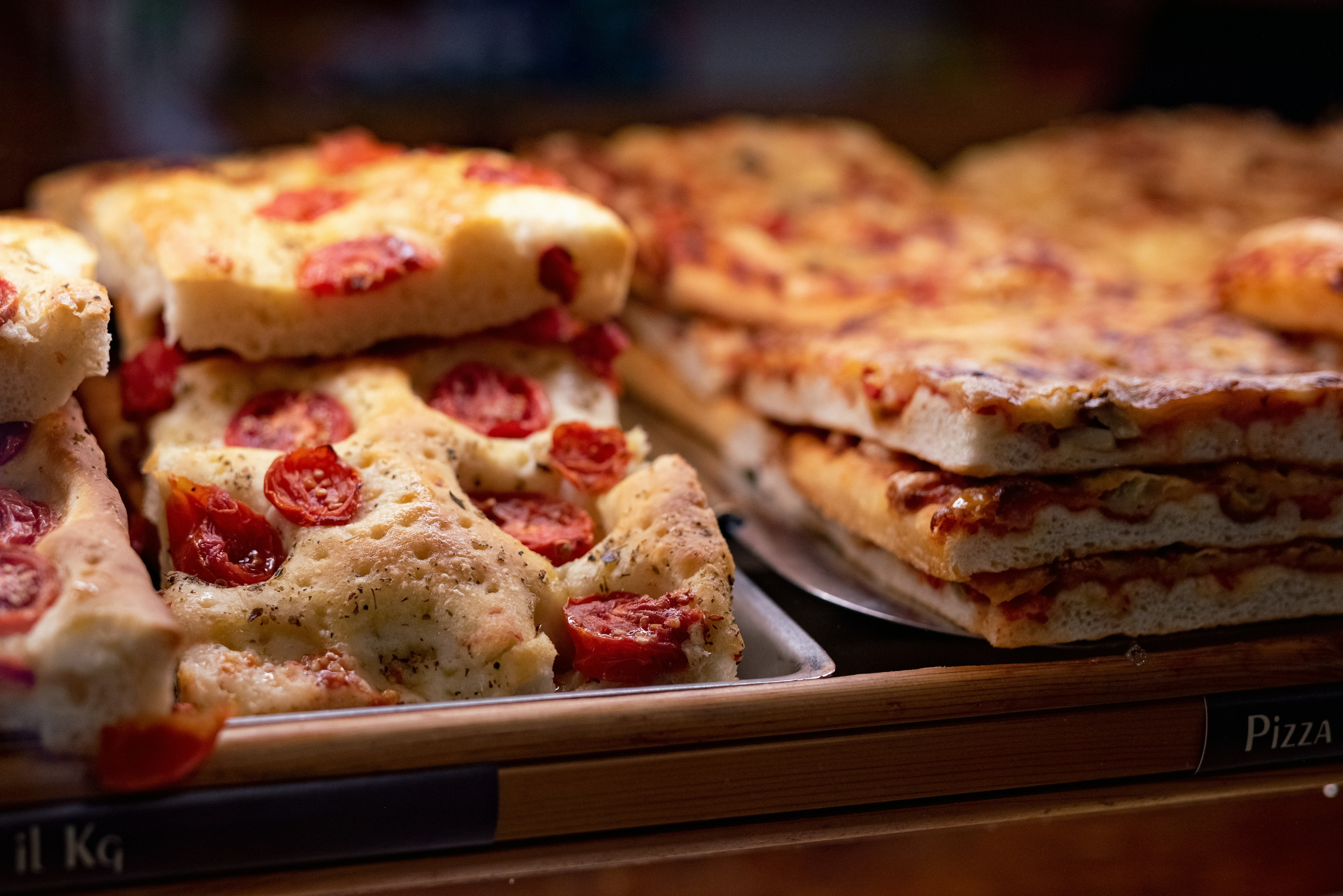
Dimples, oil and coarse salt — Genoa's focaccia is built to catch the light.
Some breads are a quiet accompaniment to a meal. Genoese focaccia is not one of them — it's the meal, the snack, the breakfast and the reason to leave the house. Soft and pillowy underneath, faintly crisp on top, dimpled all over and shining with good olive oil and coarse salt, it's the pride of Genoa and the wider Liguria region. Locals call it fügassa in dialect, and once you've had a warm piece torn straight from the tray, you'll understand why an entire coastline organises its mornings around it.
What it is, and where it comes from
Focaccia in some form is found all over Italy, but the version most people picture — flat, soft, generously oily and pocked with finger-dimples — is closely tied to Genoa and the Ligurian coast. Liguria is olive-oil country, a thin green strip of terraced hills running down to the sea, and that abundance of good oil is really the heart of the bread. This isn't focaccia where the oil is an afterthought; it's brushed on, pooled into the dimples, and worked into the very texture, so the crumb stays tender and a little rich rather than dry.
The exact age of the recipe is the kind of thing food historians enjoy debating, and the romantic origin stories should be taken with a pinch of that coarse salt. What isn't in doubt is that focaccia has been a daily, everyday food in Genoa for generations — sold plain by the slab, eaten standing up, and treated less like a special treat and more like the bread you simply always have.
In Genoa, bread doesn't sit on the side of the plate. It is the plate.
How it's made — and the breakfast quirk
The method looks simple and, like the Paris baguette, that simplicity is exactly what's hard to fake. A soft, well-hydrated dough is stretched into a tray, then the baker presses fingertips deep across the surface to make the signature dimples. Those little wells aren't decoration: they hold the oil and a light brine often brushed over the top, so as it bakes you get pockets of salty, savoury moisture and a surface that turns golden and just-crisp while the inside stays soft.
Then there's the habit that surprises visitors most. In Genoa, dipping a piece of plain focaccia into a morning cappuccino is a genuine, much-loved local breakfast — not a quirky one-off but something people grow up doing. It sounds odd until you try it: the warm, milky coffee softens the salty, oily bread, and the sweet-and-savoury contrast is oddly addictive. If you see locals doing it at a bar counter first thing, that's the real Genoa, not a tourist performance.
Variations, and the famous cousin from Recco
Plain focaccia genovese is the everyday default, but it's far from the only one. Bakeries (the focaccerie) often turn out versions topped with sliced onions, olives, rosemary, sage or even small potatoes, each adding its own character without straying from the soft, oily foundation.
The most famous relative, though, comes from the nearby coastal town of Recco. Focaccia di Recco is a different animal: two paper-thin sheets of unleavened dough — no yeast — sandwiching soft, melting stracchino (also called crescenza) cheese, baked hot until blistered and golden. It's thin, crisp and gooey rather than soft and bready, and it's protected and celebrated as a speciality in its own right. If Genoese focaccia is the everyday hero, focaccia di Recco is the special-occasion star — worth a detour if you're in the area.
How to buy and eat it like a local
This is the easy part. Walk into a focacceria or bakery, point at what you want, and it's usually sold al taglio — by weight, cut to order from a big tray. You tell them roughly how much you'd like (a piece, a couple of etti) rather than asking for "a focaccia." A few pointers:
- Buy it fresh and warm. Like any oily, additive-free bread, it's at its best within hours of baking; cold next-day focaccia is a sad shadow of the real thing.
- Use your hands. No plate, no fork — it's street-and-counter food, eaten as you walk or stand.
- Try the cappuccino dip at least once, in the morning, like a local. You can always go back to eating it plain.
- Look at the top. A good one glistens, with visible dimples and pooled oil and salt — pale, dry and uniform is a warning sign.
And here's the gentle argument I'd make: in a country where pizza gets all the glory, Genoa quietly shows that flat bread, olive oil and salt — handled with care — can stand entirely on their own. Best for: anyone who thinks bread, olive oil and salt is one of the world's great combinations.
Go deeper
Questions
Why is Genoese focaccia so oily?
Liguria is olive-oil country, and good oil is central to the bread rather than a finishing touch. It's brushed on, pooled into the finger-dimples and worked into the dough, which keeps the crumb soft and tender. That richness — plus coarse salt and a light brine — is what makes it focaccia genovese rather than a plain flatbread.
Do people really dip focaccia in cappuccino?
Yes — it's a genuine, much-loved Genoese breakfast habit, not a tourist gimmick. The warm, milky coffee softens the salty, oily bread, and the sweet-savoury contrast wins a lot of people over. If you spot locals doing it at a bar in the morning, that's the real thing.
What's the difference between focaccia genovese and focaccia di Recco?
They're quite different breads. Focaccia genovese is soft, thick, yeasted, dimpled and oily — the everyday bread of Genoa. Focaccia di Recco, from the nearby town of Recco, is two thin sheets of unleavened (no-yeast) dough filled with soft stracchino cheese and baked until blistered — thin, crisp and gooey rather than soft and bready.
How do I buy focaccia in Genoa?
Go to a focacceria or bakery and buy it al taglio — by weight, cut to order from a tray. Rather than asking for "a focaccia," say roughly how much you'd like and point at the kind you want. Eat it fresh and warm, with your hands, the same day.
Can focaccia really rival pizza?
In Genoa, that's not a stretch. Pizza tends to get the spotlight, but Genoese focaccia shows that flat bread, good olive oil and salt — handled with real craft — make a great food in their own right. It's best for anyone who already loves that simple bread-oil-salt combination.
This guide is researched and cross-checked rather than a personal trip report, and is general information only. Recipes, customs and bakeries vary and can change — check locally for current information, and mind any dietary or allergy needs (gluten, dairy in cheese-filled versions) before tucking in.